
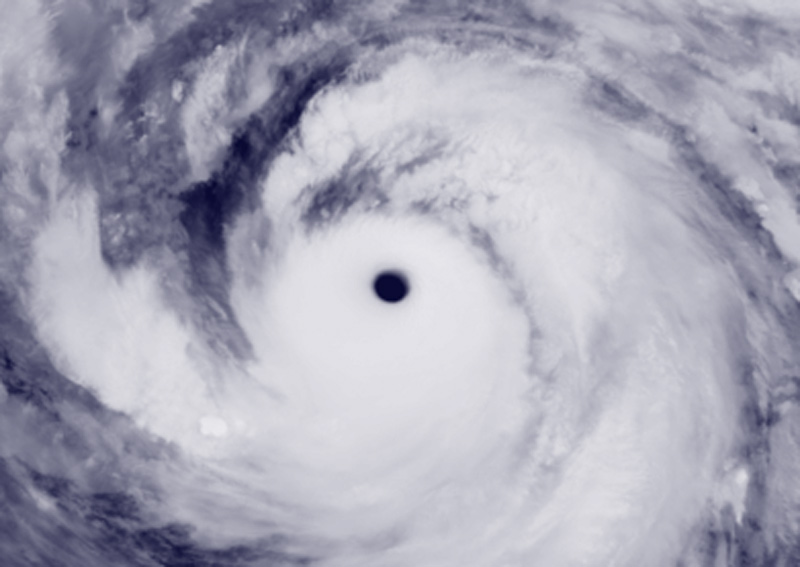
Darilaut – Typhoon Choi-wan rapidly intensified into a Super Typhoon southeast of Japan’s Ogasawara Islands—or north of the Northern Mariana Islands—in the northwestern Pacific Ocean early Monday (October 5).
Choi-wan’s eyewall is clearly defined, spanning 40 km. Super Typhoon Choi-wan is currently located 610 km from the Ogasawara Islands and 1,480 km south-southeast of Tokyo, or 950 km north-northeast of Saipan, Northern Mariana Islands.
Choi-wan—Japan’s 27th typhoon of the season—is classified as a “Very Strong Typhoon.” The Japan Meteorological Agency (JMA) stated on Monday that Choi-wan is moving slowly northward.
The system has a central atmospheric pressure of 925 hPa (hectopascals).
The JMA reported maximum sustained winds near the center of 50 meters per second (95 knots) and peak instantaneous wind speeds of 70 meters per second (135 knots).
The storm-force wind area (winds of 50 knots or greater) extends 165 km (90 nautical miles) from the center.
According to the JMA, the area of strong winds (30 knots or greater) extends 850 km (450 nautical miles) to the south and 650 km (350 nautical miles) to the north.
Maximum significant wave heights have reached 14.6 meters (48 feet), according to the Joint Typhoon Warning Center (JTWC).
The JTWC reported that Choi-wan is located 593 km east-southeast of Iwo To and has been moving north-northwest at a speed of 7 km/h (4 knots) over the past six hours. Choi-wan is expected to move generally northward.
Its forward speed will increase significantly starting on the second day, as Choi-wan is caught up in a mid-latitude low-pressure trough and interacts with strong upper-level airflow.
Extratropical transition (ETT) is forecast to begin in 60 hours and conclude within approximately three days.
In terms of intensity, Choi-wan is expected to begin weakening gradually at a steady rate—dropping by 20 km/h (10 knots) every 12 hours—over the next 60 hours.
This weakening trend could accelerate depending on the timing and severity of an eyewall replacement cycle.
If the outer eyewall completely chokes off the inner eyewall, the rate of weakening could increase.
After 12 hours, ocean heat content will begin to decline, further supporting this weakening trend.