
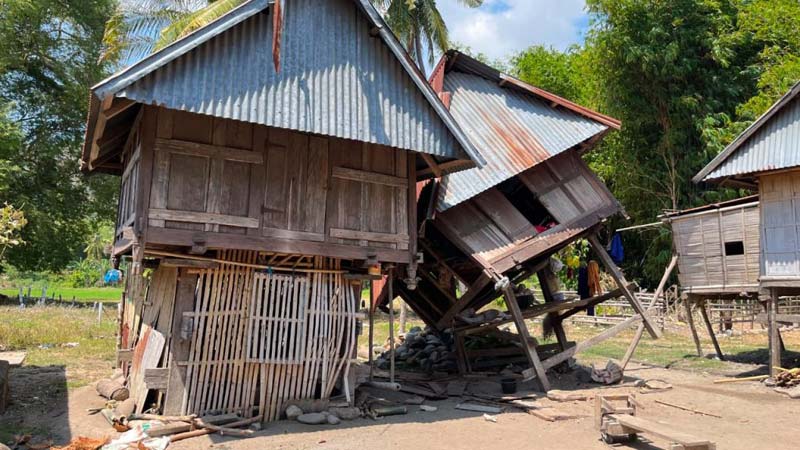
Darilaut – A magnitude (M) 7.7 earthquake in East Nusa Tenggara (NTT) on Saturday morning (August 15) caused damage to more than 2,600 buildings.
A total of 2,403 houses and 213 other public facilities sustained damage.
Joint teams are continuing data collection efforts amidst a series of 995 aftershocks recorded up to Sunday afternoon (August 16); 46 of these aftershocks were felt following the initial M 7.7 quake.
The National Disaster Management Agency (BNPB) reported that, as of Sunday afternoon, the total number of damaged houses in NTT included 1,543 severely damaged, 328 moderately damaged, and 532 slightly damaged units.
Damage also affected public facilities, including 87 educational facilities, 50 places of worship, 76 government offices, and various other public amenities.
Preliminary data from Sunday afternoon indicates a death toll of 53 people and 137 injuries.
Joint teams are continuing to track displaced residents. As of Sunday, 5,488 people were staying in centralized shelters, while another 171 had sought shelter independently.
The Head of the National Disaster Management Agency (BNPB), Lieutenant General Dr. Suharyanto, has issued directives regarding the emergency response following the M 7.7 earthquake that struck the Flores Island region of East Nusa Tenggara.
During a coordination meeting with various ministries, agencies, and local governments at the West Manggarai Regent’s Office in NTT on Sunday (August 16), the BNPB Head outlined eight strategic priorities requiring immediate execution to accelerate evacuation, logistics provision, and the initial recovery of the affected areas. First, the Head of BNPB urged the local governments of the six severely affected regencies (Manggarai, East Manggarai, Ngada, Ende, Nagekeo, and Sikka) and the NTT Provincial Government to immediately issue an official declaration of emergency status. Establishing this legal emergency status is vital to ensure that BNPB, the Ministry of Public Works, and relevant agencies have the legal framework needed to fully channel budgetary support and technical assistance to the affected areas.
Second, the Head of BNPB called for the accelerated establishment of Task Force Command Posts (Posko) at the regency/city and provincial levels, optimizing the role of TNI (military) and Polri (police) personnel as task force commanders. Establishing these local emergency posts is crucial to ensure that all tactical movements, management of displaced persons, and logistics distribution at the local level are coordinated under a single, integrated command.
Third, the Head of BNPB is directly overseeing the establishment of a Main National Support Command Post in Labuan Bajo and a Tactical Command Post in Maumere. This division of operations into two locations is designed to ensure rapid, precise, and equitable coverage of all affected regencies across western and eastern Flores.
“We are establishing the National Command Post for Provincial Support, with its primary hub here in Labuan Bajo. Given the vastness of the area, we are also opening a Command Post in Maumere to serve Sikka, Nagekeo, and Ngada. We hope these two locations will effectively coordinate all disaster response efforts,” he said.
Fourth, the Head of BNPB is coordinating the establishment of a National Logistics Post at Halim Perdanakusuma, Jakarta. This centralized hub is tasked with receiving and distributing various forms of aid—from ministries, agencies, state-owned enterprises (BUMN), the private sector, and the general public—directly to the reception point in Flores via air transport.
Fifth, regarding resident safety, the Head of BNPB has instructed the joint team—coordinated by Basarnas (the National Search and Rescue Agency)—to lead search and rescue (SAR) operations and ensure no victims remain trapped or missing. Operations to sweep through the debris are being intensified with the support of the TNI (military), Polri (police), and volunteers until the affected areas are declared completely safe.
Sixth, the Head of BNPB has set a target to restore vital facilities—such as electricity, clean water, fuel supplies, and communication networks—to limited operational status within seven days. He also emphasized that the assessment of damage to residents’ homes must be conducted concurrently, without waiting for the emergency response period to conclude. Rapid initial data collection is crucial to allow for the immediate implementation of plans for Temporary Shelters (Huntara) or home repairs.
Seventh, the Head of BNPB is coordinating the deployment of multi-agency assets, including helicopter and naval fleets belonging to the TNI, Basarnas, and BNPB. These air and sea assets are fully focused on reaching the most inaccessible locations to transport food supplies, blankets, and evacuation tents.
Eighth, the Head of BNPB has ordered the operation of an official Media Center to hold regular press briefings every afternoon at 17:00 WITA (Central Indonesian Time). This media center aims to provide transparent, day-to-day data updates while curbing the spread of confusing information and disinformation among the public.