
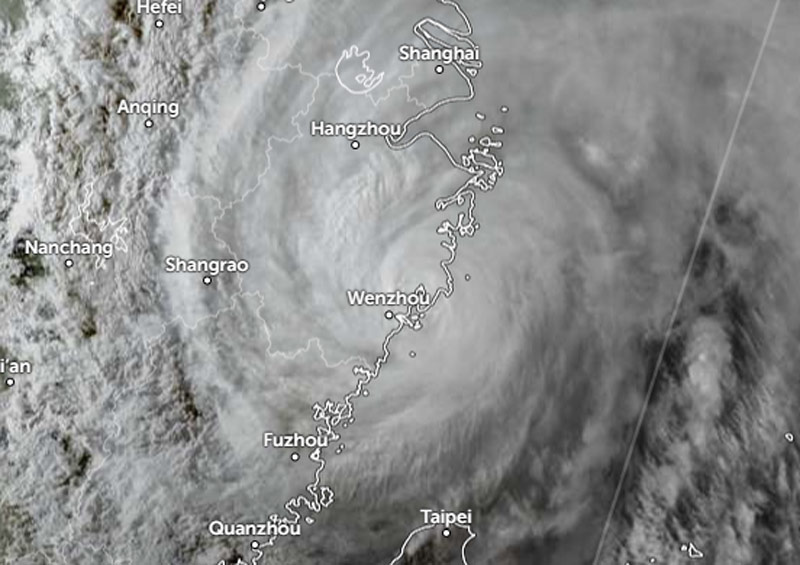
Darilaut – Typhoon Dolphin made landfall on the coast of Yuhuan—an area administered by Taizhou City, Zhejiang Province, East China—on Sunday (August 9) afternoon.
The landfall location is nearly identical to where Typhoon Bavi made landfall on the Zhejiang coast on the night of Saturday, July 12.
Dolphin moved westward from the East China Sea, bringing strong winds, heavy rain, and high waves upon landfall.
Maximum significant wave heights reached 9.1 meters (30 feet); the Joint Typhoon Warning Center (JTWC) reported that Dolphin would make landfall along China’s southeastern coast, south of Taizhou City.
According to the Hong Kong Observatory (HKO), Dolphin made landfall near Taizhou, Zhejiang.
At 18:00 local time, the center of Dolphin was located approximately 50 kilometers east of Wenzhou.
The storm is expected to move westward at a speed of about 18 kilometers per hour across Zhejiang and further inland, the HKO stated.
Earlier, at 16:00 on Sunday, the HKO reported the center of Dolphin was approximately 90 kilometers east of Wenzhou.
Overall, the system is expected to move westward along the southern edge of a strengthening subtropical ridge to the north over the next 12 hours, then turn northwestward as the ridge slightly retreats eastward, according to the JTWC.
No significant change in intensity is expected in the short term prior to landfall. After making landfall, the system is expected to weaken rapidly and dissipate over east-central China within two days.
The Japan Meteorological Agency (JMA) reported that Dolphin packed maximum sustained winds of 40 meters per second (80 knots) near its center, with peak instantaneous wind speeds reaching 60 meters per second (115 knots). The system is moving westward at a speed of 20 km/h (11 knots) and has a central pressure of 950 hPa (hectopascals).
The area with wind speeds of 50 knots or higher extends 220 km (120 NM) to the east and 150 km (80 NM) to the west. The area with strong winds of 30 knots or higher extends 650 km (350 NM) to the east and 390 km (210 NM) to the west, according to the JMA.