
Darilaut – The Student Community Service program (KKN) is a component of the academic curriculum for earning course credits, including at Universitas Muhammadiyah Yogyakarta (UMY). This year, one of the UMY KKN service locations is in East Nusa Tenggara (NTT) Province.
A total of 61 UMY KKN students were deployed to West Manggarai Regency and East Manggarai Regency in NTT.
The KKN team was divided into two groups. The first group, Gema Pelita Nusantara (GPN), consisted of 26 students assigned to Macang Tanggar Village, Komodo District, West Manggarai Regency.
The second group, Proyek Ekspedisi Nusantara (PENA), consisted of 35 students assigned to Nanga Mbaling Village, Sambi Rampas District, East Manggarai Regency.
On Saturday morning (August 15), as usual, the UMY KKN students on cooking duty were preparing breakfast. Suddenly, there were strong vibrations and rolling ground motion. The earthquake’s shaking was intense.
A massive earthquake with a magnitude (M) of 7.7 struck East Nusa Tenggara (NTT) at 04:58:24 WIB (Western Indonesian Time) or 05:58:24 WITA (Central Indonesian Time). The epicenter of this powerful quake was located 30 km northeast of Mbay, Nagekeo Regency.
Based on the shaking intensity map from the Meteorology, Climatology, and Geophysics Agency (BMKG), the strongest shaking reached Modified Mercalli Intensity (MMI) scale VII in the areas of Aesesa (Nagekeo Regency), Riung (Ngada Regency), and Kota Ambai, as well as in areas where direct micro-observations were conducted in the Manggarai and Ruteng regions. MMI scale VI was recorded in Wolowae (Nagekeo) and Bajawa City, while MMI scale V was felt in several surrounding areas. The UMY Community Service (KKN) students experienced more than just ground shifting and intense shaking; shortly thereafter, the hamlet head—in the area where they were conducting their service—directed them to head immediately for the hills.
A tsunami had been detected.
“The local hamlet head immediately instructed residents and us students to head up to the hills as soon as the tsunami threat was detected,” said Didan Oktanova Hermawan (Awan), a UMY KKN student representative, recounting the events on the umy.ac.id website.
The UMY KKN students did not rush to the hills immediately; the evacuation prioritized vulnerable groups, who were transported using open-bed trucks.
The students and other residents walked to the safety of the hills, while a number of fishermen quickly took their boats out to sea.
BMKG monitoring stations recorded the tsunami arriving at ten coastal points with varying wave heights.
BMKG’s sea-level observation network (tide gauges) recorded tsunami waves reaching peak heights of 1.61 meters in Reo Manggarai and East Manggarai, 0.94 meters in Maurole Ende, and exceeding 0.5 meters in Bulukumba and Sape Bima. BMKG officially lifted all tsunami early warnings at 07:30 WIB (Western Indonesian Time) or 08:30 WITA (Central Indonesian Time).
Disaster Volunteers
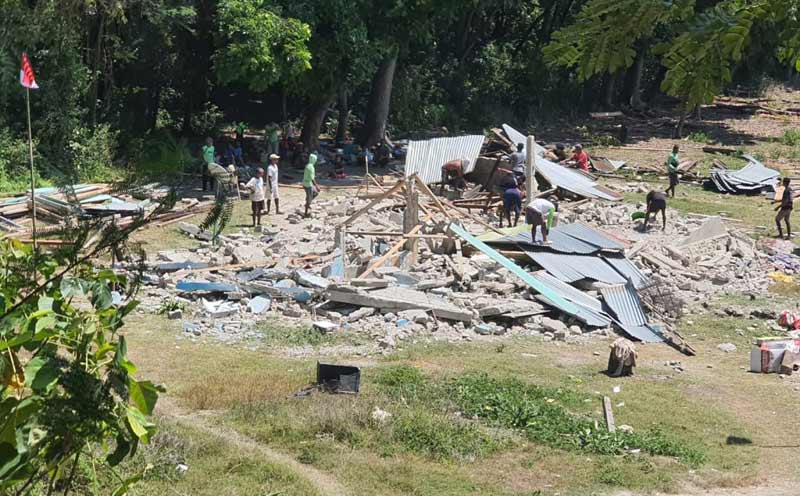
As of Saturday afternoon, there were no reports of fatalities at the UMY KKN assignment location. The main earthquake triggered panic among residents, resulting in minor injuries for some. Physical damage also occurred in several locations, including a mosque in Nanga Mbaling.
In response to the emergency situation on the ground, the team adjusted all previously planned KKN work programs. The students shifted their focus to disaster relief volunteering under the coordination of their Field Supervisor (DPL) and the local government.
The UMY KKN team was reassigned to serve as disaster relief and emergency response volunteers. UMY Vice-Rector for Resources, Prof. Dr. Dyah Mutiarin, stated that all UMY Community Service Program (KKN) students in Flores are reported to be safe.
“Praise be to God, all UMY KKN students are safe. We are maintaining communication with the team on the ground to monitor the situation of both the students and the local communities affected in the KKN locations,” said Prof. Arin, as quoted by Umy.ac.id.
“Our students at the disaster sites immediately adjusted their programs. They have been quick to assist residents on the ground, including by managing a public kitchen and helping meet residents’ emergency needs.”
For the time being, “we will strive to provide assistance within our means and in accordance with the needs of the community on the ground,” said Fifin Anggela Prista, a member of the UMY KKN *Ekspedisi Nusantara* (PENA) 11 project team in Nanga Mbaling Village.
Many residents have sustained injuries ranging from minor to severe that have not yet received adequate treatment.
As of Sunday (August 16), markets, shopping centers, and medical services in the district were paralyzed. Many affected residents have suffered minor, moderate, and even severe injuries that “have not been treated due to the limited supply of medicines and medical equipment we brought with us,” said Fifin.
First Aid
Most injuries occurred when people fell while trying to escape to safety. The majority of the injured were women who panicked during the initial earthquake, leading to slips and falls.
UMY’s Community Service (KKN) students provided wound care using first aid kits brought to the site. This response was supported by emergency preparedness training from the university and the presence of an internal health division within each student group.
In addition to emergency medical care, the students shared their personal rice supplies to provide meals for residents at the evacuation sites.
Logistical aid from the local government and the Regional Disaster Management Agency (BPBD) had not yet arrived at the location, while village officials were still coordinating with local authorities.
Independent Evacuation and Logistics Crisis
The disruption of shopping centers made it difficult for the community to obtain food and clean water. Residents in the coastal area of Pota Village and its surroundings have evacuated and set up tents independently near the UMY KKN command post.
Aid distribution was also hampered by road accessibility issues. Inter-regency access routes suffered damage at several points, complicating the mobilization of relief supplies.
“In Pota Village, the community in the coastal area and its surroundings has been widely affected,” said Fifin, adding that residents had evacuated and erected tents on their own.
“The most urgent needs right now are logistics, medical supplies, and drinking water.”
The KKN students also collected data on evacuation sites to forward to the Muhammadiyah Disaster Management Center (MDMC). This data will support coordination with the local BPBD and the nearest PKU Muhammadiyah Hospital, which is already on standby at the disaster site.
UMY acted quickly to respond to the earthquake. In addition to ensuring the safety of all KKN students, UMY distributed initial aid to students and residents in the affected areas.
UMY also launched a fundraising campaign on campus and is dispatching logistical aid in stages. Following the disbursement of rapid-response funds for field operations, a subsequent shipment of physical aid was dispatched to the disaster site.
This follow-up aid included 20 tarpaulin tents, 100 blankets, family kits, medicines, vitamins, and basic food supplies.
UMY Rector Prof. Dr. Achmad Nurmandi explained that the university, through LazisMu UMY, maintains structured coordination with the LazisMu headquarters and the Muhammadiyah Disaster Management Center (MDMC).
This integrated coordination is crucial to ensure that the assessment of needs, fundraising, and aid distribution in the field are well-integrated and effectively targeted, the Rector stated.
LazisMu UMY has also officially launched a humanitarian donation drive to gather public support. All collected funds will be distributed through Muhammadiyah’s integrated disaster relief mechanism to support the recovery of communities affected by the earthquake in NTT.
Fatalities and Injuries
Preliminary data from the National Disaster Management Agency (BNPB) records 53 fatalities resulting from the magnitude 7.7 earthquake in NTT. Forty-five of the deaths occurred in Manggarai and East Manggarai Regencies.
As of Sunday (August 16) at 16:00 WIB, the identified fatalities included 25 people in Manggarai Regency and 20 in East Manggarai. Additionally, there were 4 deaths in Sikka, 1 in West Manggarai, 1 in Nagekeo, and 2 in Ende.
In addition to the fatalities, joint response teams have evacuated and provided medical care to the injured. The total number of injured victims stands at 137. Currently, the injured are receiving treatment at nearby health facilities or emergency medical posts.
Building Damage
The earthquake in NTT on Saturday morning caused damage to more than 2,600 buildings. As of Sunday afternoon, the BNPB recorded a total of 1,543 heavily damaged houses, 328 moderately damaged houses, and 532 lightly damaged houses in NTT. Additionally, 213 public facility buildings sustained damage.
Joint teams are continuing damage assessment efforts amidst a series of aftershocks—totaling 995 events by Sunday (August 16) afternoon—of which 46 were felt following the initial magnitude 7.7 earthquake.
The BNPB has moved quickly to support emergency response operations, providing assistance that includes logistics and emergency response equipment. This aid is part of the central government’s response to support local authorities in addressing the community’s basic needs and strengthening services for disaster-affected residents. (VM)