
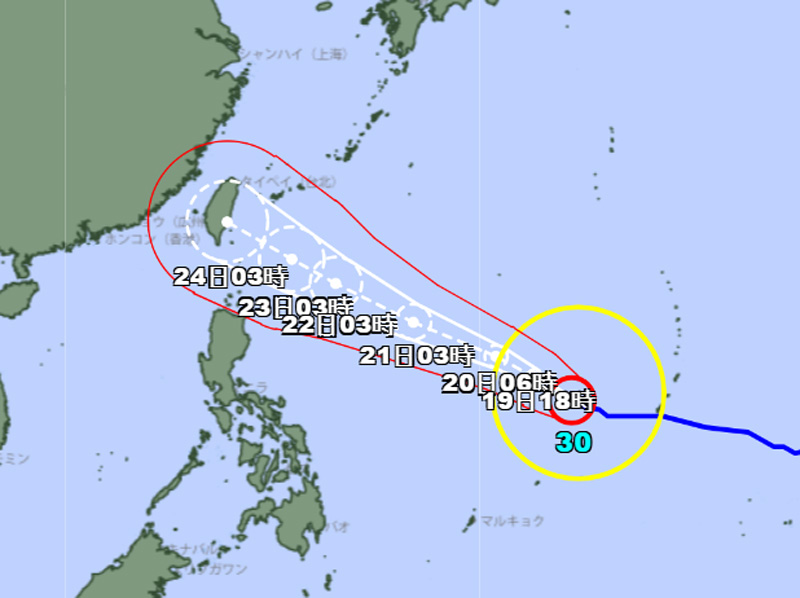
Darilaut – Super Typhoon Champi is heading toward the area east of Taiwan. As of Monday morning (October 19), Champi is located west of Guam—or north of Jayapura, Papua—in the Western Pacific Ocean.
According to tracking data from the Japan Meteorological Agency (JMA) and Zoom.earth, Champi—designated as the 30th typhoon of the season—is moving toward the east of Taiwan.
The JMA classifies Champi as a “Very Strong Typhoon,” currently moving in a west-northwesterly direction at a speed of 15 km/h (9 knots).
The system is large in scale, with a central air pressure of 960 hPa (hectopascals).
Champi packs maximum sustained winds of 45 m/s (90 knots) near its center, with peak instantaneous gusts reaching 65 m/s (130 knots).
The JMA reports that an area with wind speeds of 50 knots or greater extends 130 km (70 nautical miles) from the center, while an area with strong winds of 30 knots or greater extends 560 km (300 nautical miles) to the northeast and 440 km (240 nautical miles) to the southwest.
According to the Hong Kong Observatory (HKO), Tropical Cyclone Champi is expected to move across the waters east of Luzon (the Philippines) over the next few days. However, there is uncertainty regarding its subsequent path.
The HKO suggests the cyclone could either head toward the southeastern coast of China or turn northward, moving toward the Ryukyu Islands and into the East China Sea.
The Joint Typhoon Warning Center (JTWC) indicates that maximum significant wave heights could reach 14 meters (46 feet).
At the same time, the cyclone’s forward speed has slowed slightly due to the formation of a col—a meeting point between two high-pressure systems—to the north, which has weakened the steering gradient.
Regarding intensity, the JTWC indicates that an eyewall replacement cycle appears to have concluded, and general atmospheric conditions are now favorable for a resumption of intensification.
Over the next two days, the system will traverse waters with some of the highest ocean heat content in the Western Pacific, providing a robust source of thermodynamic energy to fuel continued intensification, according to the JTWC.