
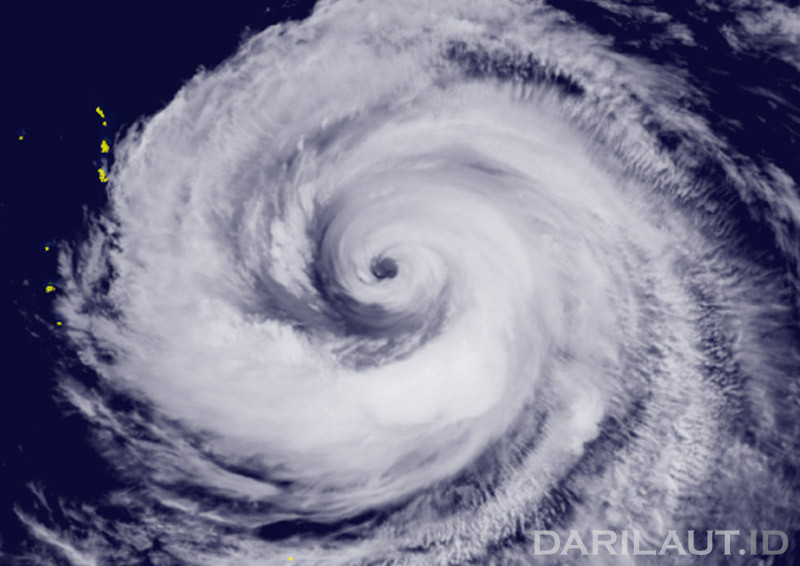
Darilaut – Super Typhoon Dolphin in the western North Pacific Ocean is moving west-northwest toward Japan’s Okinawa Islands and the East China Sea. As of Monday (8/3) afternoon, Dolphin is located north of the Northern Mariana Islands and Guam.
According to the Hong Kong Observatory (HKO), Tropical Cyclone Dolphin in the western North Pacific will move across the sea south of Japan over the next few days and generally track around the East China Sea by this weekend. However, HKO noted that uncertainty remains regarding its subsequent movement.
Dolphin, currently at “Very Strong Typhoon” intensity, is moving generally west-northwest at a speed of 25 km/h (13 knots), according to the Japan Meteorological Agency (JMA).
The atmospheric pressure at its center is 945 hPa (hectopascals).
Maximum sustained winds near the center are 45 meters per second (85 knots), with peak instantaneous wind gusts reaching 60 meters per second (120 knots).
According to the JMA, the storm area with wind speeds of 50 knots or higher covers a radius of 185 km (100 NM). Strong winds of 30 knots or higher extend across a radius of 560 km (300 NM).
The maximum significant wave height is 13.7 meters (45 feet), according to the Joint Typhoon Warning Center (JTWC).
The JTWC forecasts that Dolphin will maintain a relatively stable intensity throughout the forecast period. Dolphin is expected to weaken slightly over the next 24 hours as an eyewall replacement cycle continues, then maintain an intensity of around 155 km/h (85 knots) for the next 4 days before weakening slightly further.
The JTWC stated that if Dolphin fails to complete its ongoing eyewall replacement cycle, it could accelerate its weakening and compound the negative effects of lower ocean heat content.
The eye and wind field will remain quite large over the next 5 days, bringing impacts across Japan’s entire Ryukyu Islands regardless of the exact position of the storm’s center, the JTWC said.
Uncertainty in the intensity forecast stems from the ongoing eyewall replacement cycle and the resulting fluctuations in intensity.