
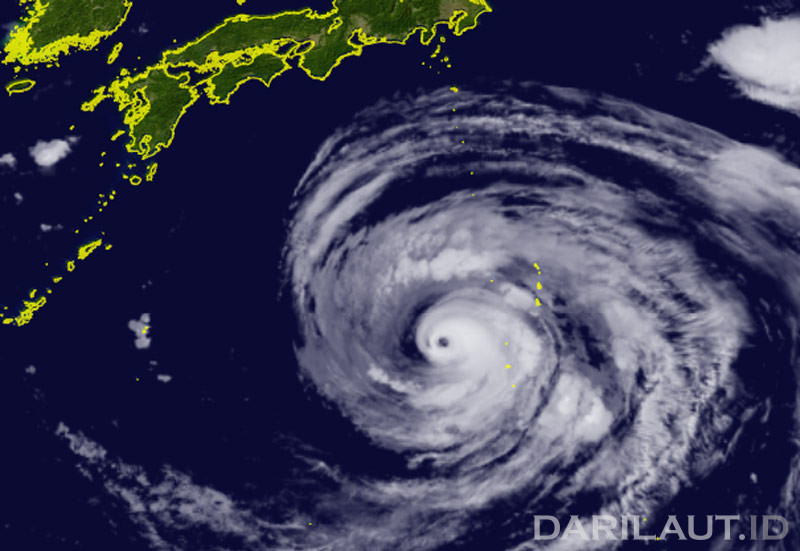
Typhoon Dolphin has been moving westward at 22 km per hour (12 knots) for the past six hours. The maximum significant wave height was 15.2 meters (50 feet), according to the Joint Typhoon Warning Center (JTWC).
The JTWC expects the system’s travel speed to slow to only 5–10 km per hour (4–5 knots) once the system moves into the East China Sea.
In the final forecast period, the system will begin to gradually slow toward the northwest.
Dolphin is expected to make landfall in Okinawa in about three days before moving out into the East China Sea, the JTWC said.
Regarding intensity, the JTWC said the system appears to have reached a stable state, achieving a balance between competing environmental factors.
The JTWC envisions the system weakening slightly over the next 12 hours, then maintaining its intensity for the next 36 hours before beginning a gradual weakening trend until it makes landfall in Okinawa.
This is primarily due to slightly lower sea surface temperatures due to oceanic upwelling and reduced upper-layer outflow.
The system will then weaken more rapidly as it slows and upwelling becomes more significant.
While its intensity is expected to continue to decrease, the wind field is expected to continue expanding, with strong winds expected to cover an area of nearly 1,111 km in the East China Sea over the next five days.